
Wellness-first, not medical claims
Menopause changes more than people often expect, and pelvic floor strength is one of the quieter shifts. In my Kirkham studio I offer HIEMT chair sessions as a wellness-first option for pelvic floor menopause concerns. Here is what it does, what it does not, and where your GP comes first.
What changes in the pelvic floor around menopause
The pelvic floor is a hammock of muscles and connective tissue that sits at the base of the pelvis. It supports the bladder, the uterus, the lower bowel, and the surrounding ligaments, and it does its work quietly across most of life. Around menopause, several things shift at once. Oestrogen levels decline, and oestrogen has a real role in tissue elasticity, collagen turnover, the way the muscles hold their tone, and the natural moisture balance of the area. The connective tissue softens. The muscles can lose some of their natural recoil. None of this is a personal failing. It is biology, well-documented, and recognised by every clinician who works with women in this stage of life.
The result, for many women in my Kirkham studio, is a quiet noticeable shift. Sometimes it is mild leakage with a sneeze or a brisk walk. Sometimes it is a sense of looseness or heaviness that was not there ten years ago. Sometimes it is the awareness that lifting a grandchild needs a different bracing pattern than it used to. Sometimes there is no obvious symptom at all, and the person simply wants to do something supportive before any symptom appears. All of these are valid reasons to think about pelvic floor strengthening, and most pelvic floor menopause conversations in my Kirkham studio land somewhere on this spectrum.
Why I added the HIEMT chair to my Kirkham studio
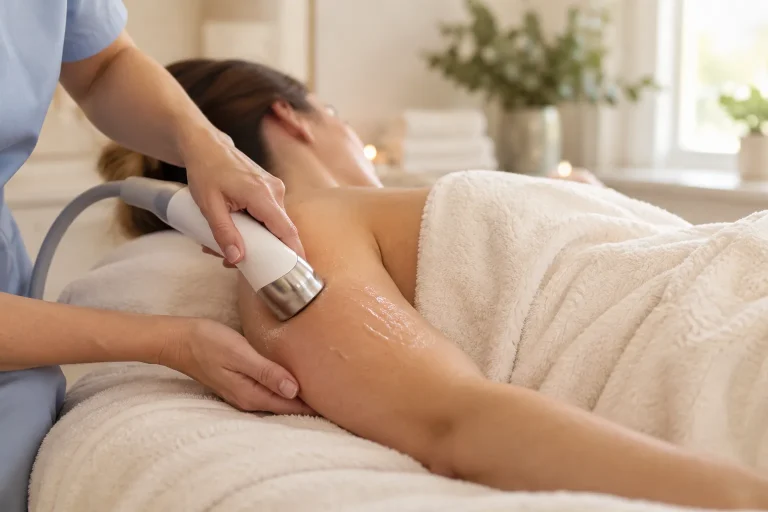
I bought the HIEMT chair as much for the women who come to me as for myself, and pelvic floor menopause concerns are now one of the most common reasons clients book a consultation. The chair uses electromagnetic stimulation to contract pelvic floor muscles thousands of times in a single thirty-minute session, more than anyone could realistically do with voluntary Kegels at home in a week. The science is straightforward. The energy reaches the muscle through clothing, the muscle contracts hard and repeatedly, and the body responds the way muscles always respond to consistent training. They get stronger. They hold tone better. They support better.
For the menopause cohort specifically, what the chair offers is a practical way to keep working the muscle even when the hormonal environment is making everything else harder. It is a wellness-first option. It is not a hormone treatment, not a substitute for medical care, not a replacement for HRT or any prescribed medication, and not something I would suggest instead of seeing your GP if you have a new or worsening symptom. It sits alongside the rest of the picture, not in place of it.
Where HIEMT fits and where it does not
What HIEMT can support, in plain language: the strengthening of the pelvic floor muscle group through repeated contractions that the body could not produce voluntarily at the same intensity. Many of my clients in their fifties and sixties report fewer everyday concerns after a course. Things like more confident exercise, fewer worries about long walks, easier carry-and-lift moments with grandchildren, and more secure bracing patterns through the day. That is muscle work doing its job.
What HIEMT will not do, and where I want to be very clear: it does not address hormone-related symptoms. It does not raise oestrogen. It is not a treatment for medical prolapse, urinary incontinence as a clinical condition, any pelvic-related pathology, or post-surgical recovery work. It cannot replace HRT, and it does not work on the vaginal lining or the urethral wall directly. If your concern is hormonal, it belongs with your GP first, then perhaps with HIEMT alongside if your GP thinks it appropriate. That is the line I keep on every pelvic floor menopause consultation.
Who I refer to a GP first, before any HIEMT
Restraint is the technique here too. There are situations where a HIEMT course is genuinely not the right starting point, and I would rather you spend the consultation cost on a GP visit than on a session in my chair.
You should see a GP first, before any HIEMT booking, in the following situations: a new or sudden change in continence or pelvic sensation that has appeared in the last few months without an obvious cause, a history of pelvic surgery in the last six months that has not yet been signed off by your surgical team, active pelvic infection or unexplained pelvic pain, a pacemaker or metallic implants in the pelvic region or any electronic medical device in the area the chair stimulates, pregnancy at any stage, and a diagnosis of medical pelvic prolapse where a women’s health physiotherapist or consultant is already managing your care.
Once a GP has had a look and confirmed there is no underlying medical concern, HIEMT can sit comfortably alongside the rest of your wellness routine. Not before that conversation, and not as a workaround for clinician input.
What a HIEMT course looks like for the menopause cohort
A typical course is six to ten sessions, taken twice a week for the first three to five weeks. Each session is thirty minutes. You sit fully clothed in the chair. You can read a book, scroll your phone, listen to a podcast, or simply close your eyes and let the contractions do their work. There is no chemistry, no needle, no removal of clothing, and no exposure of any kind. The sensation is unmistakable, but it is not painful and it is not invasive. You can see pelvic floor prices and courses before you book.
For clients in the menopause cohort, I usually suggest combining HIEMT with light voluntary Kegel work at home between sessions, just to maintain the muscle memory between visits. Once the initial course is complete, most clients book a single top-up session at six weeks to lock the gains in, and then a maintenance session every six to twelve weeks if they want to keep the result steady. That is the realistic pattern. Not constant maintenance, just consistent enough to keep the muscle awake.
Realistic expectations and what will not change
I refuse to oversell this. The HIEMT chair is a useful tool. It is not a magic switch. The clients who come back to me happiest are the ones who started with realistic expectations, kept up with their home routine alongside the course, gave the muscle time to consolidate, and stayed in touch with me about how things were progressing.
Here is what I will not promise. I will not promise that the chair restores your pelvic floor to its twenty-five-year-old version. I will not promise that all leakage stops permanently. I will not promise that your hormonal symptoms ease, because the chair has nothing to say to your hormonal system. And I will not promise that a single course solves it forever, because muscles, like all body tissues, respond to ongoing care, not to one-off interventions.
What clients in this age range tend to report is more confident exercise, less anxiety about long social events, an improved sense of bracing during ordinary activities, and a quieter mental load around something that had been preoccupying them. That is honest data. Not transformation. Just real, modest, useful, supportive data that matters to the people experiencing it. That is the honest version of what pelvic floor menopause work tends to deliver.
How to start: a consultation, not a course
My recommendation, especially for the menopause cohort, is always to begin with a consultation rather than a course booking. We talk through your medical history, what you have already discussed with your GP, what your concerns actually are, what you want from the work, and what timeframe you have in mind. If after that conversation HIEMT is the right starting point for you, we book the first session. If a different route is the right starting point, I will say so directly.
You can see my full pelvic floor treatment page for the technical details on what HIEMT involves and the typical course structure. If you are also considering broader cosmetic body work alongside the pelvic floor focus, my body sculpting page covers what else is available in the same studio.
Questions & Answers
Book a HIEMT consultation in Kirkham
If you are noticing pelvic floor changes around menopause and you would like to think through whether HIEMT might suit, book a consultation at my Kirkham studio. We start with conversation, not commitment. Use the button below to find a date that works for you.
All treatments carried out by Maria at Skincare & Waxing, 10A Freckleton Street, Kirkham, Preston, PR4 2SP