
How can we remove skin tags?
How can we remove skin tags safely? The honest answer is that there are several routes, some safer than others, and the right one depends on what you actually have. Here’s what I do at my Kirkham studio, what I don’t, and how to think it through before you act.
What a skin tag actually is
A skin tag is a small, soft growth of normal skin tissue, usually attached to the body by a thin stalk. They appear most often on the neck, eyelids, under the arms, beneath the breast, and in skin folds. They are not viral. They do not spread. They are usually a cosmetic concern rather than a medical one.
Skin tags often get confused with other small skin features. Moles look different and behave differently. Warts have a rough surface, sometimes a small dark dot in the centre, and are caused by HPV – these I do not address; warts are a GP or pharmacy matter, not mine. Seborrhoeic keratoses are pigmented patches that sit raised on the skin and are something a GP can review. Skin cancer signs are a separate category – anything that has changed colour, size, or shape rapidly, has irregular edges, or bleeds without obvious cause needs urgent GP review, never my chair.
Calling something a skin tag without checking is the first place people go wrong.
Methods people use to remove skin tags
Plenty of options exist. Some are reasonable; others I would not recommend.
Over-the-counter cryotherapy kits sold in UK pharmacies are designed for warts and verrucas, not skin tags, and using them on skin tags can cause inconsistent freezing or skin damage around the base. Tying a thread around the stalk of a skin tag (sometimes called ligature) is an old home method that occasionally works but can lead to infection or partial removal that needs follow-up. Cutting a skin tag at home with scissors is a route some people try, and one I see go wrong fairly often.
Clinical methods include cryotherapy at a GP surgery, surgical excision (also at GP or dermatology), ligation under sterile conditions, and Advanced Electrolysis as I use at my Kirkham studio. Each has a slightly different profile.
I work with electrolysis because it offers precision, no cutting, no stitching, treatment of the growth at its base, and minimal disruption to the skin around it.
Why I do it the way I do
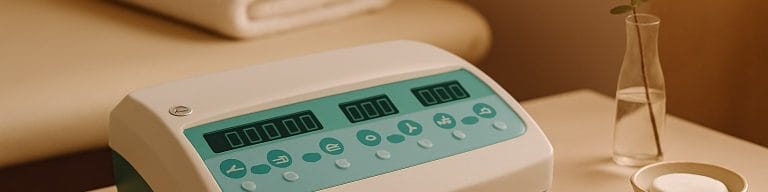
I use a Sterex Advanced Electrolysis device. A fine sterile probe delivers a small electrical current directly to the base of the skin tag. The growth dries out and falls away naturally over the following days.
The reason I prefer this over snipping or freezing is the level of control. I can adjust current, dwell time, angle, and probe choice for each individual growth depending on size and location. Eyelid tags, neck tags, tags under the arm, and tags in the bra-strap line all behave slightly differently and benefit from individual settings rather than one-size-fits-all.
There is also the matter of what comes back. When a skin tag is treated cleanly at the base, that specific growth does not regrow. New ones may appear elsewhere later in life because of friction, age, hormonal change, or genetic predisposition, but that is a new event, not a return of what we addressed.
What I won’t do
There are things that are not within my scope and never will be. I want to be clear about them so you can plan correctly.
I do not remove warts of any kind. Viral warts and verrucas are HPV territory, and they belong with your GP or pharmacy, not with me. I do not remove anything I am uncertain about; if I have any clinical question about what I am looking at I will ask you to see your GP first. I do not promise outcomes I cannot confidently deliver.
I also do not claim to permanently rid you of skin tags as a category. New ones can appear over a lifetime. What I can do is address the ones you have, cleanly, in one or two appointments.
What an appointment looks like
A first appointment for skin tag removal at my studio starts with a proper look. I want to confirm what we are dealing with before I touch anything. If anything looks atypical I will pause and recommend a GP review first.
If we proceed, I clean the area, talk you through what I am doing, and address the growths one at a time with the electrolysis probe. The sensation is brief and very local, and most people compare it to a quick flick on the skin each time. After the procedure I apply a soothing serum and give you simple aftercare instructions: keep the area clean, avoid heat for the next twenty four hours, sun protection on healing skin.
A member of my family had multiple skin tags around his neck for years. He had stopped wearing his chain because it kept catching on them, sometimes drawing blood. We sat down together at my studio and I removed them in about thirty minutes. Years later he is still grateful and still wearing his chain.
I tell that story because it sums up what most clients in this category actually want. Not a dramatic outcome, just the small daily friction to stop. Skin tags rub on bra straps. They catch on jewellery. They irritate under the arms and below the breast. Removing them is a small intervention with disproportionate quality-of-life return.
When you should see your GP first
Please see your GP before booking with me, or with anyone else, if any of these apply:
- The growth has changed colour, size, or shape recently.
- There is bleeding, itching, or pain you cannot explain.
- You have multiple new growths appearing in a short period.
- You suspect what you have is a wart or verruca rather than a skin tag.
- The growth is on a child.
- You are immunocompromised or pregnant.
These are GP territory. I would rather you go to your doctor first and come back to me afterwards than skip a step and miss something that needed medical attention. If your GP confirms what you have is cosmetic and gives the green light, I am happy to take it from there.
If you would like to start with a calm conversation rather than a procedure, a Skin Analysis is a sensible first step. Thirty pounds, one hour, and we look at your skin properly together. Advanced Electrolysis is the dedicated service for the procedure itself once we have decided it is the right route.
Questions & Answers
Book Skin Tag Removal in Kirkham
If you’d like a calm, professional skin tag removal appointment in Kirkham, or just an honest assessment of what you have first, the booking link is below.
All treatments carried out by Maria at Skincare & Waxing, 10A Freckleton Street, Kirkham, Preston, PR4 2SP