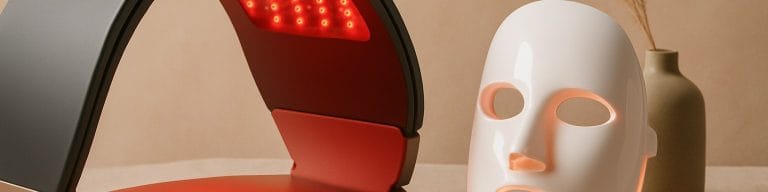

Red LED, honestly explained
Red LED light therapy gets a lot of marketing noise, especially in anti-ageing copy. I want to give you my honest version. What it does, what it does not do, why I chose Dermalux for the studio, and what a realistic course looks like for mature skin.
Why mature skin asks me about red LED first
Many of my clients in their fifties and sixties walk into the studio and tell me, before I have asked, that they want something that supports the skin without being aggressive. They have been peeled, lasered, microneedled, sometimes injected, and the conversation now is about repair as much as it is about results. Red LED light therapy comes up in this conversation more often than any other treatment in the studio.
The reason is simple. Red light is comfortable, requires no recovery, does not break the skin barrier, and pairs gracefully with the rest of a routine. It is also one of the few professional treatments where the science is reasonably well documented for anti-ageing applications. For mature skin that has had enough of the aggressive end of the cosmetic spectrum, that is a meaningful starting point.
What red LED light therapy actually does
At the skin level, red light at specific wavelengths is absorbed by the mitochondria inside skin cells, which respond by producing more cellular energy. With more available energy, fibroblast cells in the dermis tend to support increased collagen and elastin activity. The result, over a course of sessions, is skin that appears firmer, looks more even, and reflects light more like skin you remember from earlier years.
This is a supportive process, not an erasure. Red LED light therapy works alongside the skin you already have, not against it. The colour returns to a warmer, more uniform tone. Lines that were sharp soften slightly. Texture becomes more refined. Recent research on photobiomodulation has documented these patterns across several skin types and ages, which is why I am comfortable using the phrase “evidence-based” rather than “proven results”. The latter is marketing language, and I do not use it.
What red LED will not do
Red LED light therapy is not a wrinkle eraser. It will not undo the structural changes that twenty or thirty years of sun, gravity, and life have made to your face. It is not a substitute for surgical lifting if that is what you are looking for, and it is not a replacement for a corneotherapy-led skincare programme if your barrier is compromised.
What it does, honestly, is shift the appearance of the skin in a more youthful direction over a course. Lines look softer. Tone looks more even. The skin reflects light more attractively. None of that is the same as turning the clock back. I will tell you that to your face on the first consultation, and you and I will plan from there.
Why I chose Dermalux for the studio
I did not pick this LED at random. After comparing several brands across the parameters that actually matter, I chose Dermalux because the clinical evidence behind it is the strongest in the UK market, the training course is thorough, and the support after purchase is what I would want from any equipment supplier.
The parameters that matter for any red LED light therapy panel are the wavelengths it actually delivers (not the ones marketed), the number and density of the diodes, the angle and distribution of the light, and the consistency of the dose across the treatment area. Cheap home panels can light up a room and still deliver almost nothing therapeutic. Professional Dermalux panels are dense, calibrated, and stable, which is why a salon course of red LED feels different from a bathroom mirror device. Hardware quality outranks operator skill on this one. Choose the wrong panel and even a careful therapist cannot rescue the result.
What a red LED session looks like
You arrive at 10A Freckleton Street and lie down on the treatment couch in the studio. The Dermalux panel is positioned over your face at a calibrated distance. You wear protective eye shields, your eyes stay closed for the duration, and the treatment runs for around twenty minutes.
There is no heat. There is no discomfort. Most clients describe it as the most relaxing twenty minutes of their week. Some doze. Some listen to a quiet playlist on headphones. There is nothing to do except let the panel do its work. After the session, you walk out, your skin feels calm and slightly warmer, and you can apply makeup or moisturiser immediately. There is no recovery period and no aftercare beyond a sensible sun-protection routine.
The realistic timeline for visible change
For anti-ageing applications, I recommend a course of around ten to twelve red LED sessions, two per week, across four to six weeks, depending on the skin’s starting point. Most clients begin to see a difference in tone and brightness somewhere between the fourth and sixth session, with the more substantial change in texture appearing toward the end of the course.
After the initial course, I suggest a maintenance pattern of one or two sessions per month to hold the result. Mature skin in particular benefits from this slow, supportive cadence rather than from one-off sessions spaced months apart. The cellular changes are cumulative, and the maintenance schedule is what holds them in place. I will not promise an overnight change. The cellular machinery does not work that way, and anyone who tells you otherwise is selling marketing language rather than skin science.
How red LED light therapy fits alongside your home routine
Red LED light therapy works best when the skin coming in for sessions is well supported at home. That means a calm cleanse, a corneotherapy-respecting moisturiser, a daily sun-protection product, and patience. If you are using strong active ingredients, such as retinoids or acid exfoliants, the timing of those needs careful planning so the skin barrier stays intact between sessions.
I run that conversation at the Skin Analysis appointment, before booking a course of red LED. If you are exploring the broader skincare picture, my facial treatments page covers the corneotherapy-led range, and the dedicated LED light therapy page lists pricing and bookable slots.
Questions & Answers
Book your red LED consultation in Kirkham
If your home routine is already supporting your skin and you want to add red LED light therapy to the picture, book a Skin Analysis first and I will plan the course around what your skin actually needs. The studio is at 10A Freckleton Street, Kirkham, appointment-only.
All treatments carried out by Maria at Skincare & Waxing, 10A Freckleton Street, Kirkham, Preston, PR4 2SP